Logistics: the shape of the semester.
This is the practical map for the semester: what you will study, how the marks work, and when everything is due. Read it once now, then return whenever you need to check a deadline or course rule.
§0The deck at a glance
The deck covers the course rules, syllabus, assessment, seminar option, project expectations, and website. There is no NLP theory here, but these details shape the rest of the semester.
§1The opener
On the slide
The course is M23CS7.501, Advanced Natural Language Processing, taught in Monsoon '26 by Manish Shrivastava and Aparajitha Allamraju at IIIT Hyderabad. First lecture: July 30, 2026.
Why keep this in mind
Here, “advanced” means post-transformer. The course assumes you already know the older NLP toolkit and can follow a paper’s architecture diagram. It moves quickly from that starting point.
On the slide
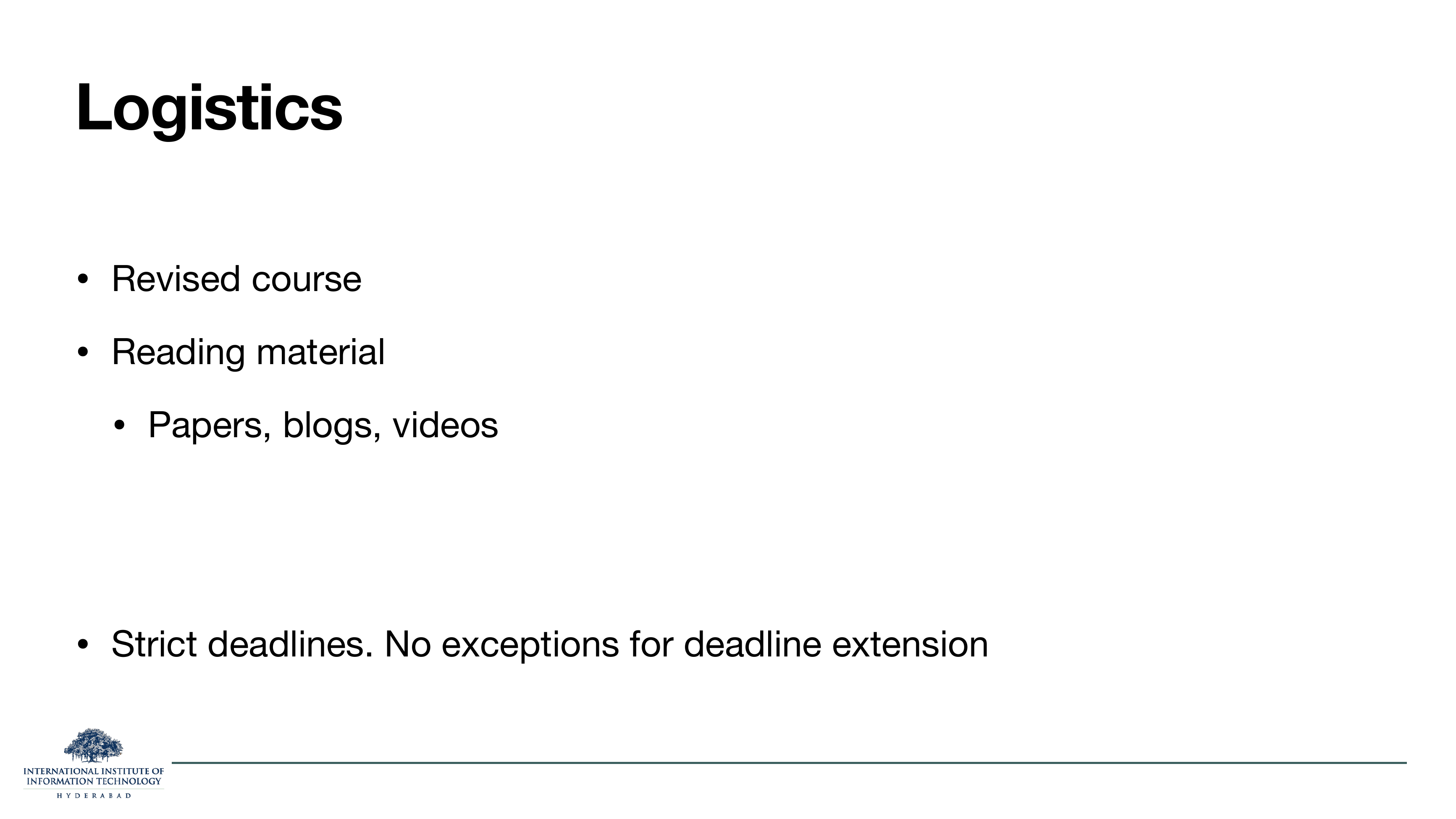
Three ground rules: (1) the course has been revised from earlier offerings, (2) reading is papers, blogs and videos, not a textbook, and (3) deadlines are strict.
What to take from it
NLP changes faster than most textbooks can. The reading list therefore mixes papers, blogs, and videos. The useful skill is learning how to follow a fast-moving field, not memorising one fixed source.
Take the deadline policy literally. Exam and project dates are tied to the institute calendar, so an extension can affect everything that follows.
§2What you'll learn
Slides 3 and 4 outline roughly 22 lectures in six themes. Keep this map handy: it makes it easier to place a new paper or idea in the wider course.
On the slide
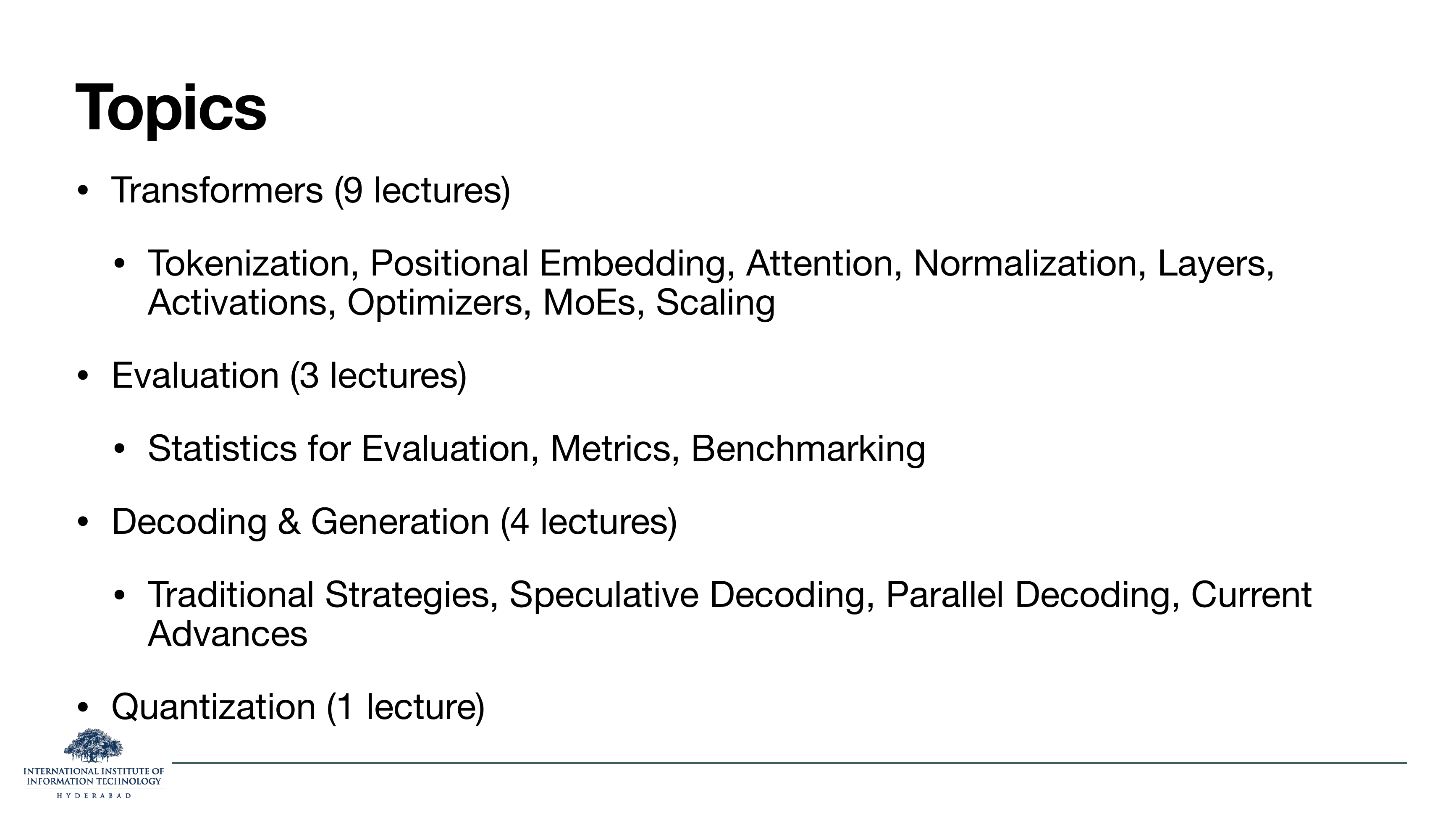
The first half of the syllabus: 17 of the ~22 lectures.
What to take from it
Nine lectures focus on the transformer: tokenization, position, attention, normalization, layer design, activations, optimizers, mixture-of-experts, and scaling laws. That focus makes sense because later topics either build on transformers or challenge them.
The remaining units cover the surrounding toolkit: evaluation, decoding and generation, and quantization. Together, they answer how to assess, use, and run large models efficiently.
The weighting is a useful signal: transformers are the course’s foundation, while quantization is introduced as an important practical extension.
On the slide
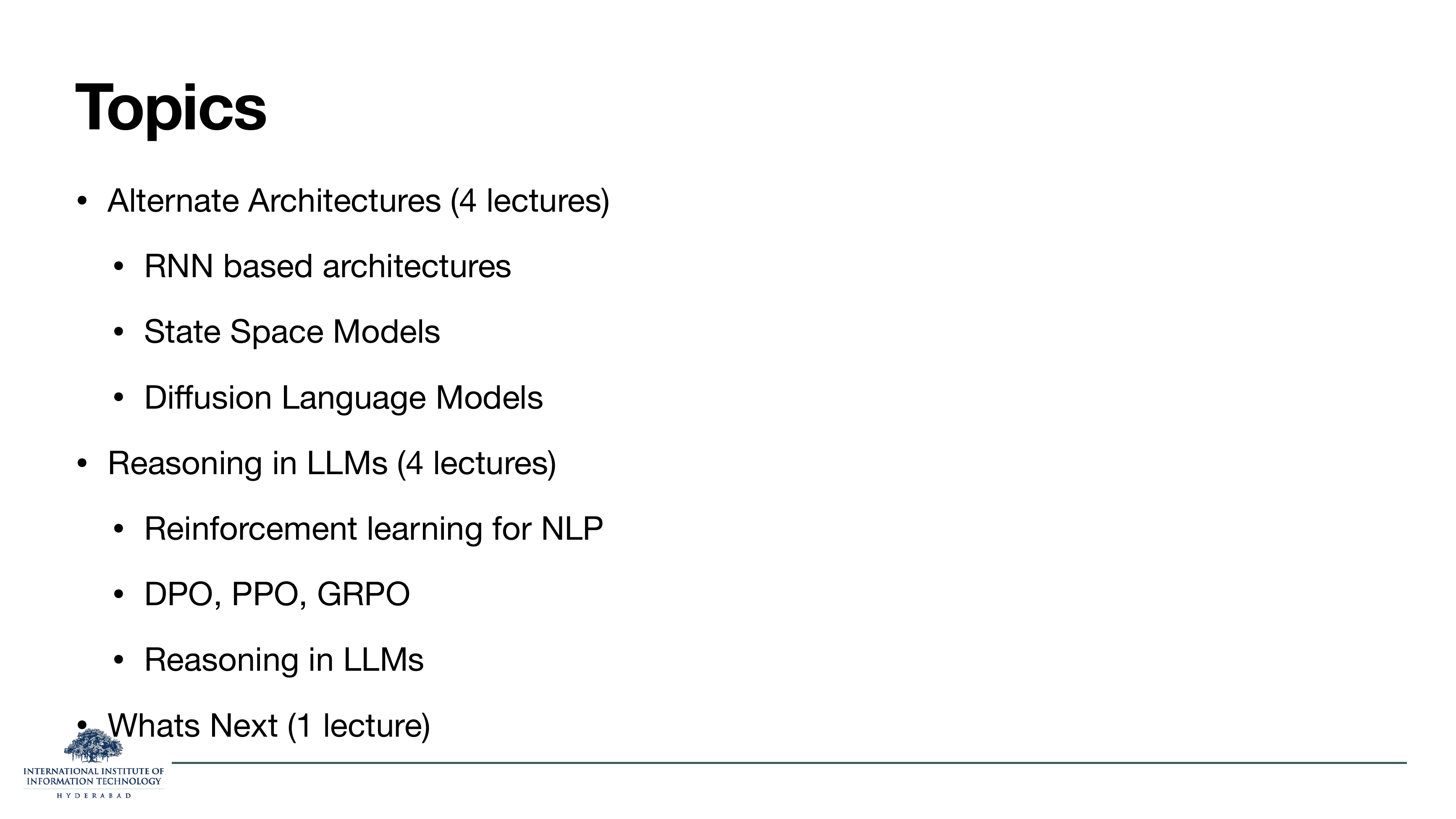
The last third of the semester. Four lectures on alternate architectures (RNN-family revival, State Space Models like Mamba, and diffusion language models), four on reasoning in LLMs (reinforcement learning for NLP; DPO, PPO, GRPO; and reasoning strategies like chain-of-thought), plus a "what's next" wrap-up.
What to take from it
Once transformers became the default, two questions became unavoidable: how can attention handle long contexts affordably, and how do we align large models with human preferences? This part of the course explores both, along with alternatives such as state-space and diffusion models.
Lecture 6, More Attention, is the first hint of the O(n²) fix. The State Space Models lecture is the second, more radical, one.
§3How you'll be graded
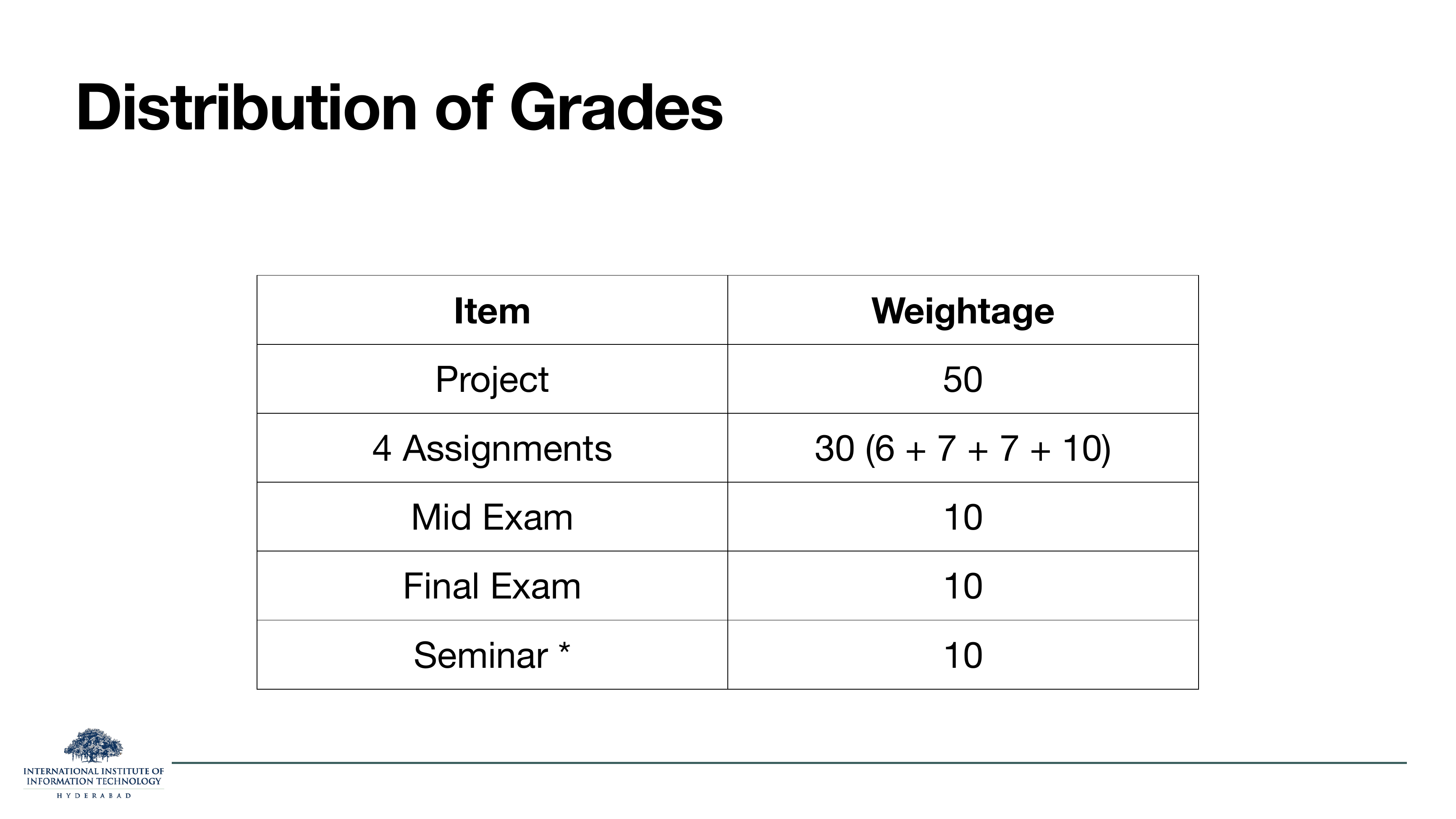
On the slide
The mark distribution across the semester.
| Component | Weight | Note |
|---|---|---|
| Project | 50 | The single biggest thing you will do. |
| 4 Assignments | 30 (6 + 7 + 7 + 10) | Escalating weight; the last one matters most. |
| Mid Exam | 10 | Per institute calendar. |
| Final Exam | 10 | Per institute calendar. |
| Seminar (opt.) | 10 | Replaces one exam if you take it (see slide 08). |
Half of your grade is the project. Another 30% is homework. Only 20% is memory-under-time. If you like doing research more than you like sitting exams, this course is built for you.
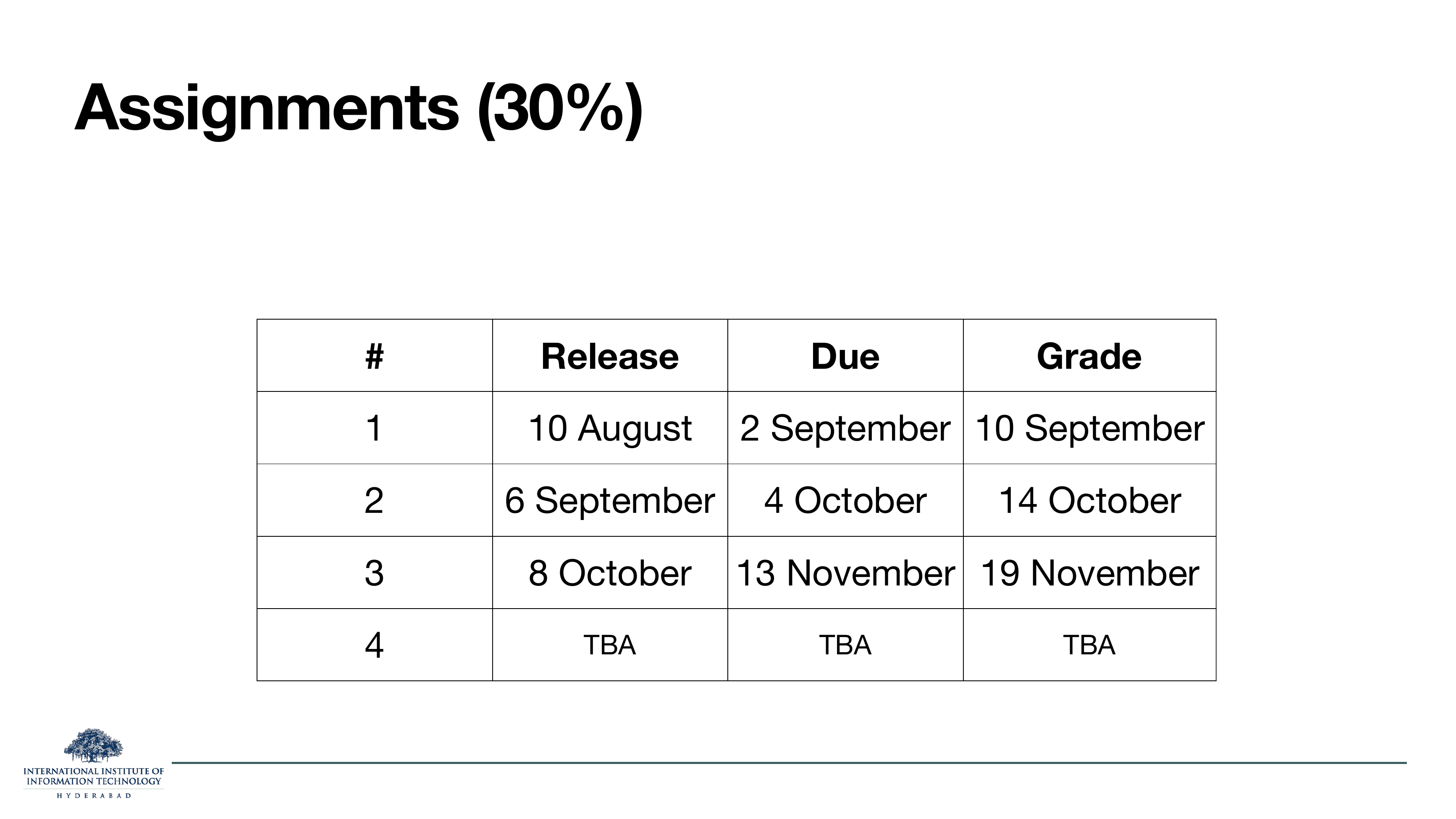
On the slide
The four assignments and their calendar. A1 released 10 Aug (due 2 Sep, graded by 10 Sep). A2 released 6 Sep (due 4 Oct, graded 14 Oct). A3 released 8 Oct (due 13 Nov, graded 19 Nov). A4 to be announced.
What to take from it
The assignments overlap. Each is open for about a month, and the next one arrives soon after the previous deadline. Plan for that overlap instead of treating each assignment as a separate sprint.
§4Exams & the seminar
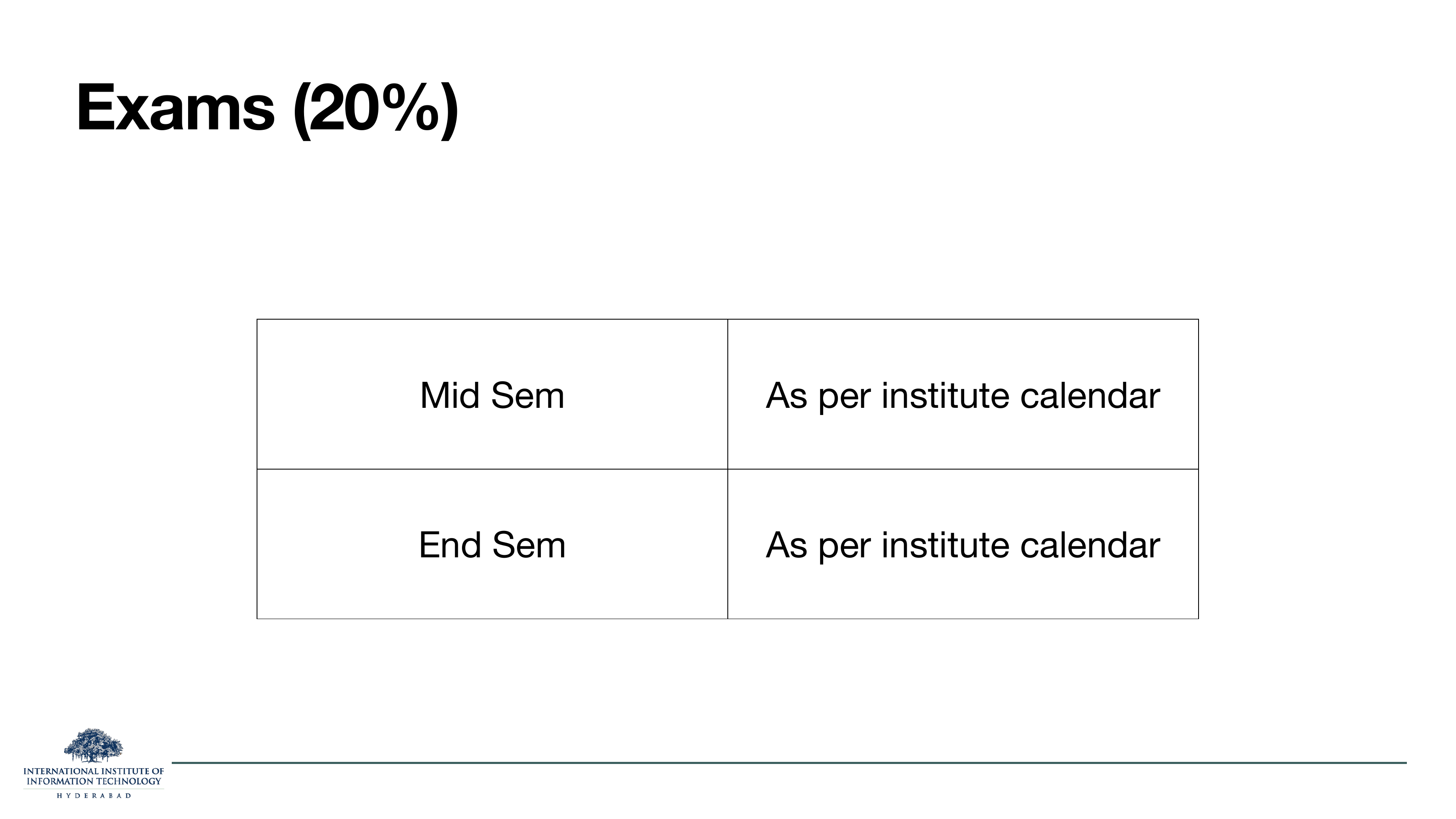
On the slide
Two exams, each worth 10%. Both are scheduled by the institute rather than the instructor.
Why keep this in mind
The past papers from 2023 and 2024 show what to expect: a short, conceptual exam that rewards clear explanations of RNNs, LSTMs, attention, and transformers more than memorised formulas.
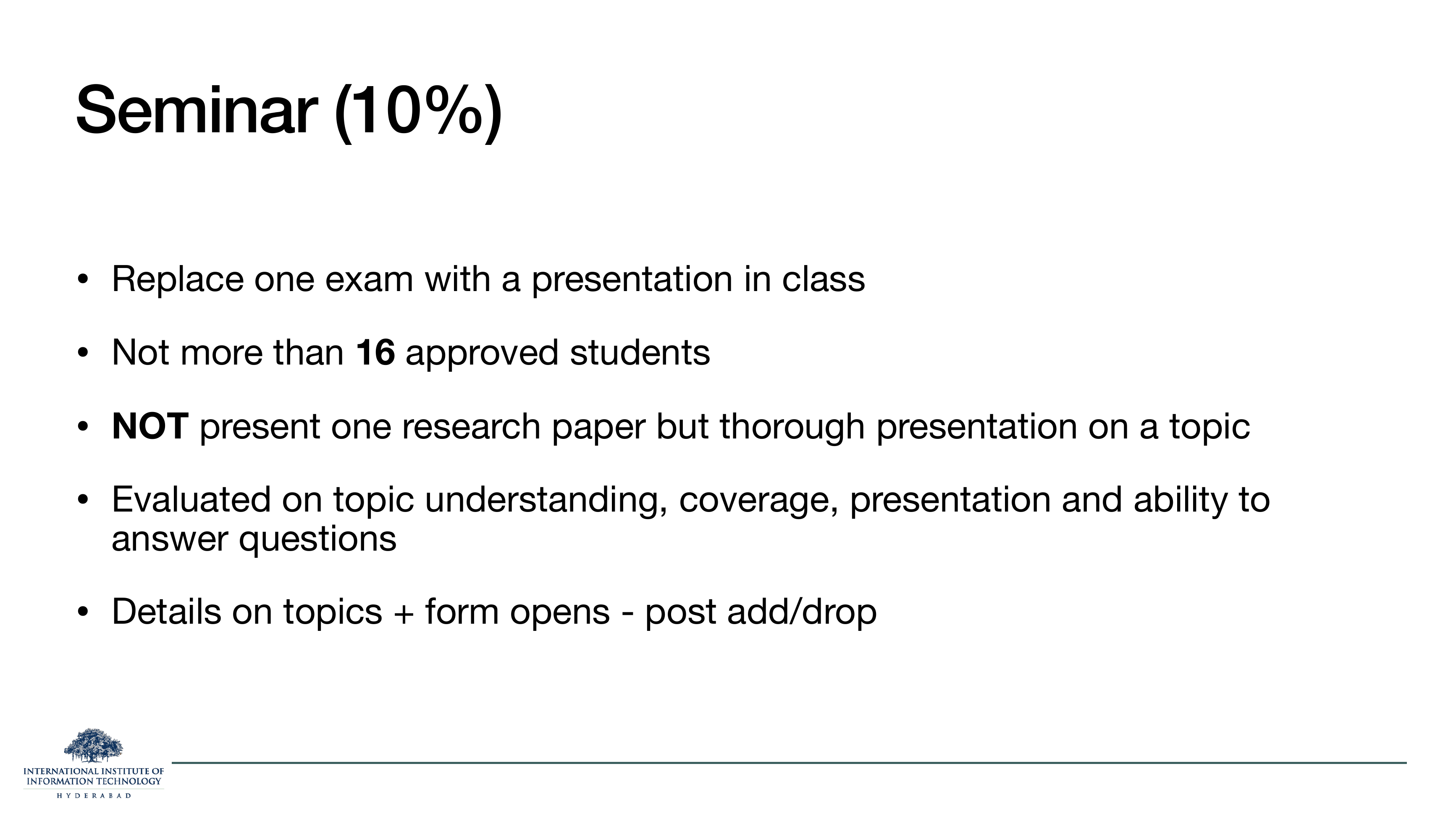
On the slide
A seminar option. Up to 16 students can pick this; if you do, you present a topic in class and it replaces one of the two exams (worth the same 10%).
What to take from it
The seminar should explain a topic, not retell one paper. Read across a small set of papers, identify the important differences, and present the field to someone new to it.
Assessment covers understanding, coverage, presentation, and your answers during discussion. A polished script helps, but it cannot replace knowing the material well enough to handle questions.
The form opens after add/drop closes. Watch the course website (slide 16) for it.
§5The project: half your grade
The project accounts for half the course grade, and its early deadlines arrive quickly. This is the part of the deck worth returning to.
Slides 9 through 15 cover the project requirements, timeline, and assessment.
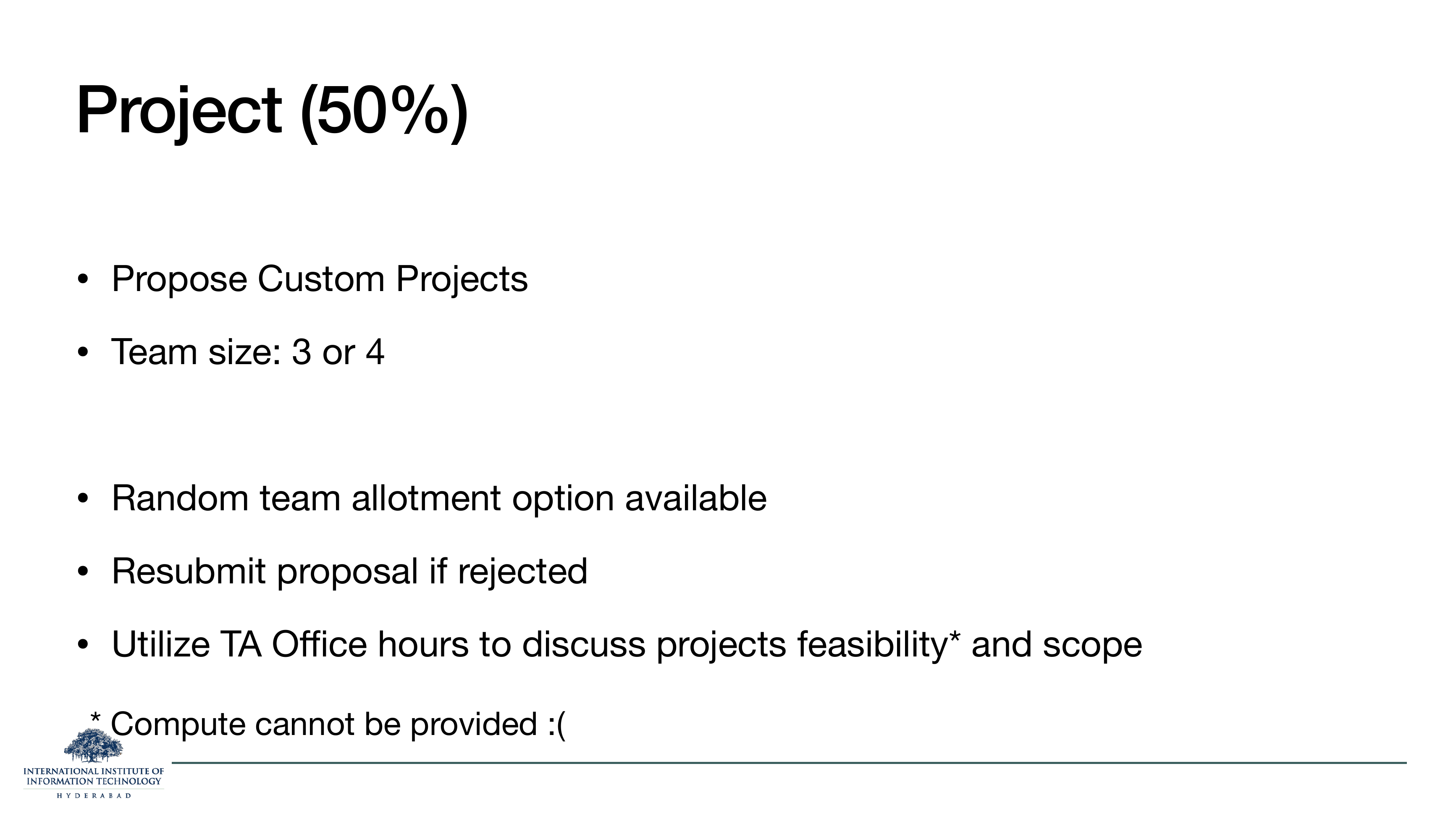
On the slide
You choose the topic and work in teams of three or four. Students without a team can be assigned one, and a rejected proposal may be resubmitted once. The course does not provide GPU compute.
Why the "no compute" line matters
Choose a project that fits the resources you actually have. Pretrained checkpoints, LoRA or QLoRA on small models, synthetic experiments, and careful evaluation studies are all realistic. Pretraining or large-scale ablations are not.
A “small” language model can still need thousands of GPU-hours to pretrain. Check the compute budget before committing to a scope.
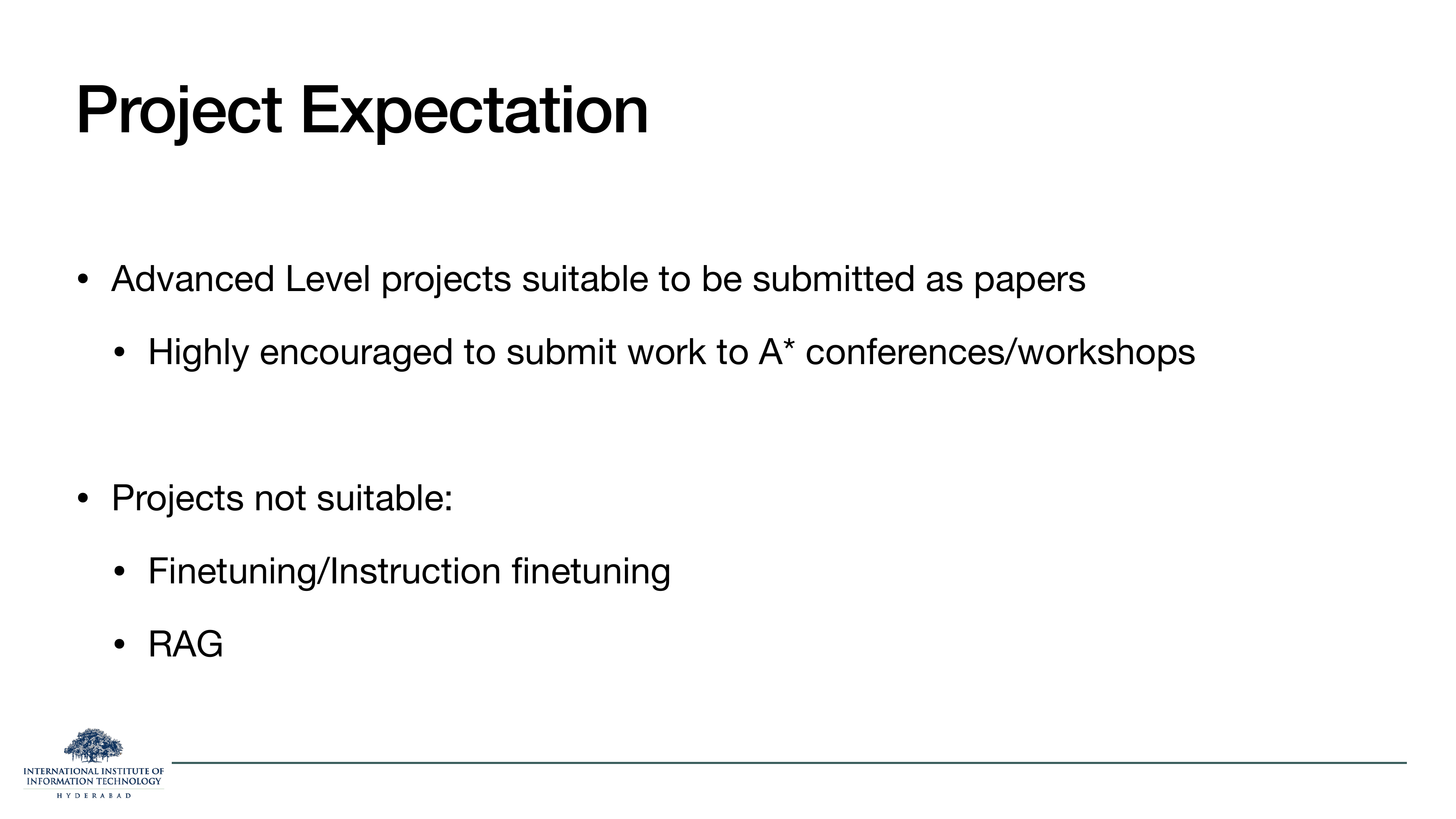
On the slide
The bar is publishable. The lecturer explicitly encourages you to submit good work to A* conferences or workshops. And two things are called out as not suitable: plain finetuning / instruction finetuning, and RAG.
Why those two are out
On their own, fine-tuning and RAG usually demonstrate implementation rather than a research contribution. The expectation is that you investigate the model, algorithm, data, or evaluation itself, rather than only wiring existing components together.
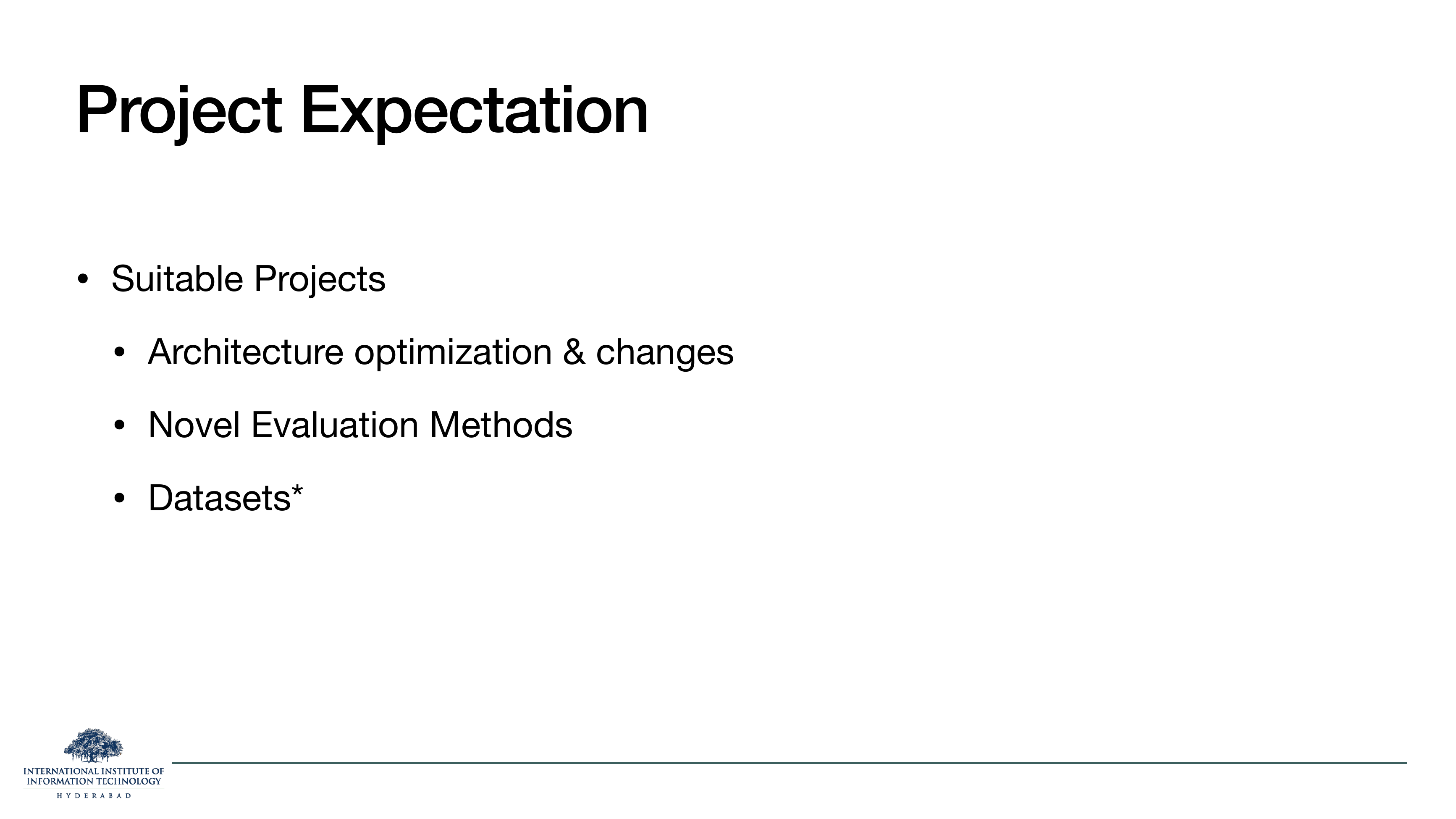
On the slide
Three kinds of project the course explicitly welcomes:
- Architecture optimisation & changes. Modify the transformer block, propose a new attention variant, plug in a state-space layer.
- Novel evaluation methods. Design a new benchmark, a new metric, or a controlled probe that catches something existing evaluations miss.
- Datasets. Curate a new dataset (with the star hinting at "if it's actually novel and non-trivial").
Why keep this in mind
These choices correspond to the three main ways to contribute to a paper: a better model, a better measurement, or better data. Choose the one you genuinely want to spend a semester exploring.
On the slide
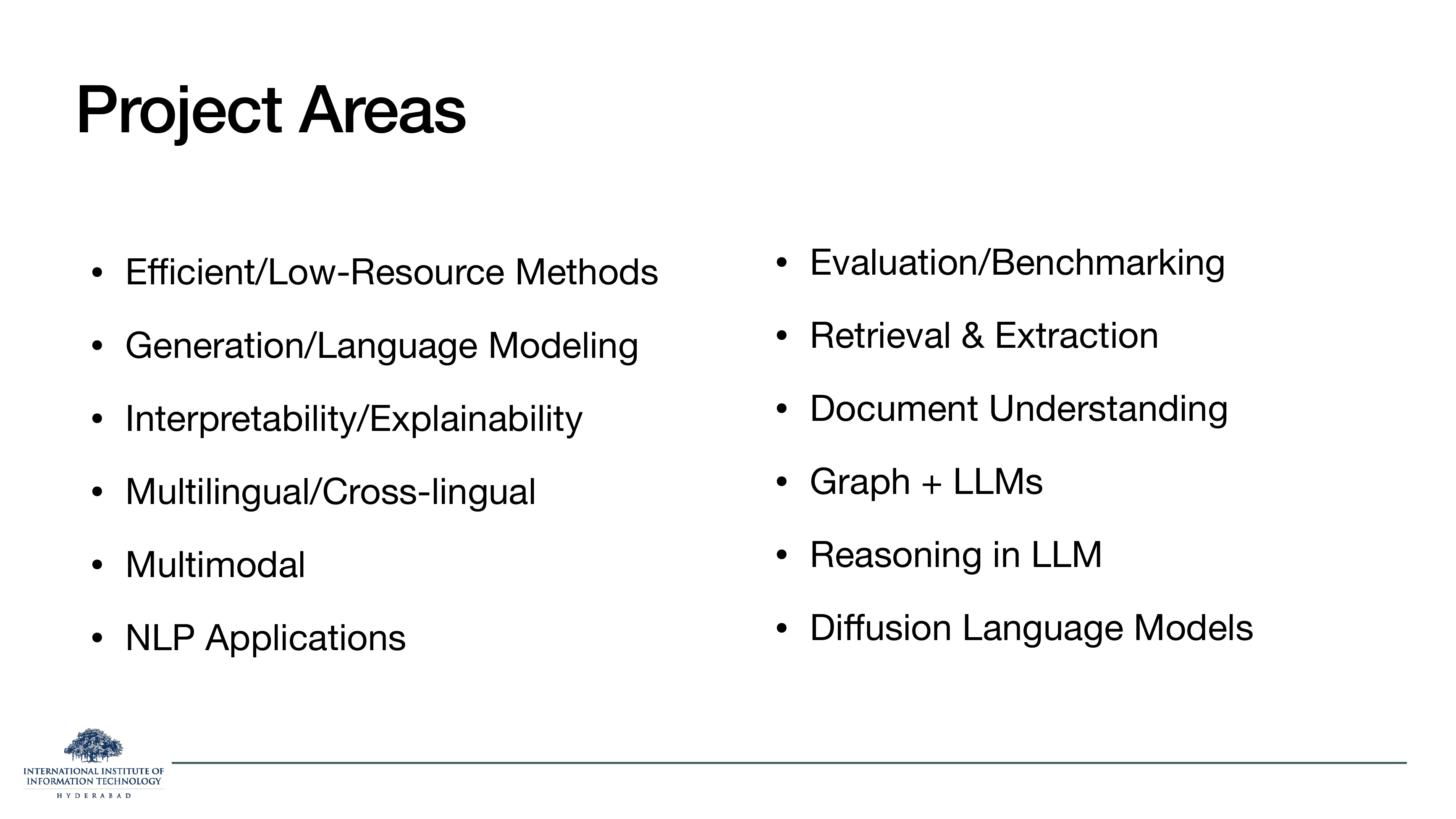
A menu of twelve project areas. These aren't project titles; they're regions of the map you can pitch inside.
How to use this list
Some of these labels will be unfamiliar at first. Revisit the list after a few lectures; by then, you will have enough context to see which directions interest you.
Several of these areas map onto later course lectures. Efficient Methods ↔ quantization + Flash Attention (Lecture 6), Reasoning in LLMs ↔ the late-semester block, Diffusion LMs ↔ alternate architectures.
On the slide
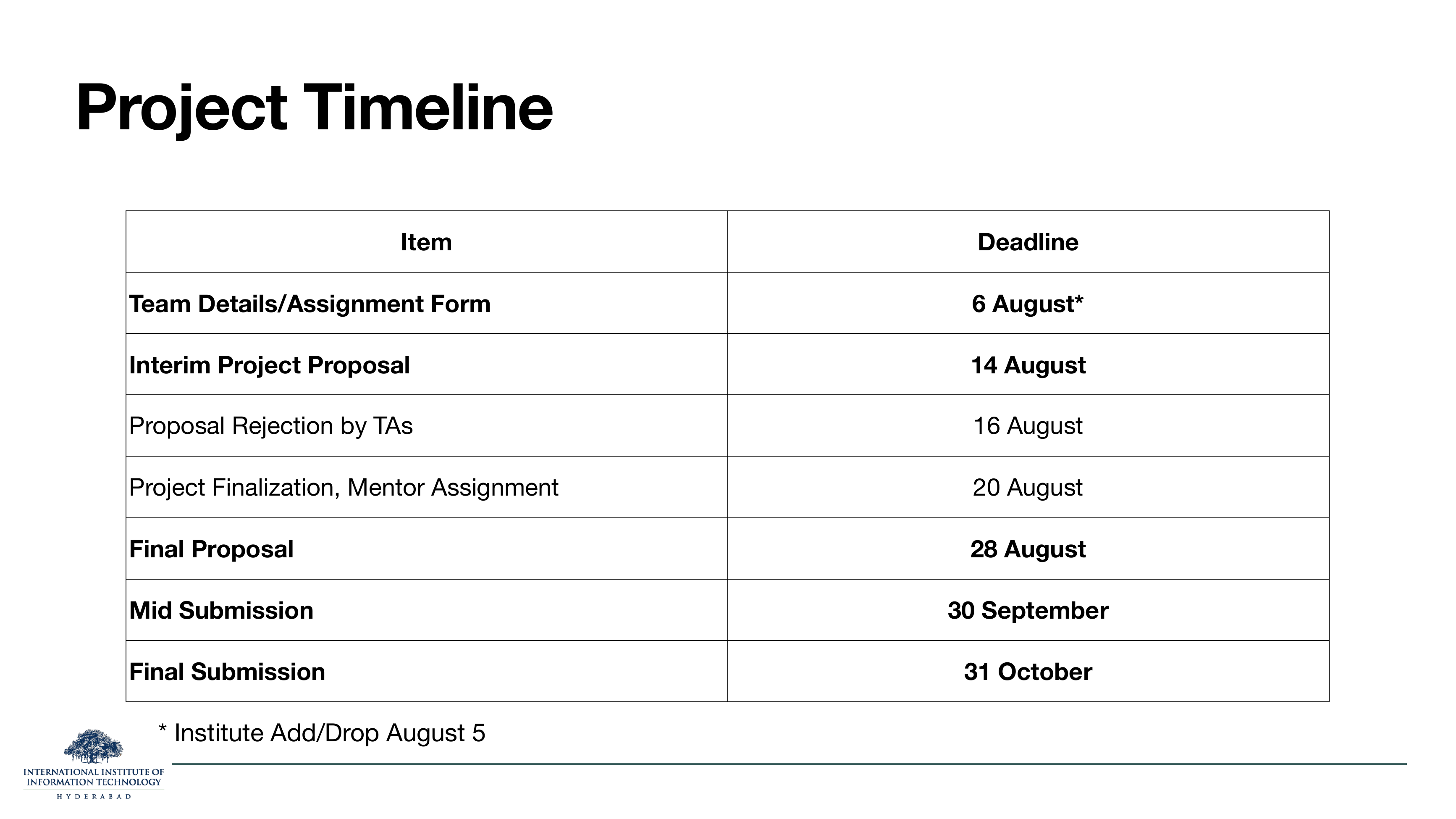
The project calendar in eight rows. The critical dates:
- 6 Aug: team & assignment form due (right after institute add/drop closes on 5 Aug).
- 14 Aug: interim proposal.
- 16 Aug: TAs return the rejection list.
- 20 Aug: proposal finalised, mentor assigned.
- 28 Aug: final proposal locked.
- 30 Sep: mid submission.
- 31 Oct: final submission.
The final proposal is due roughly three weeks after add/drop closes. Start narrowing ideas and finding teammates from the first week.
On the slide
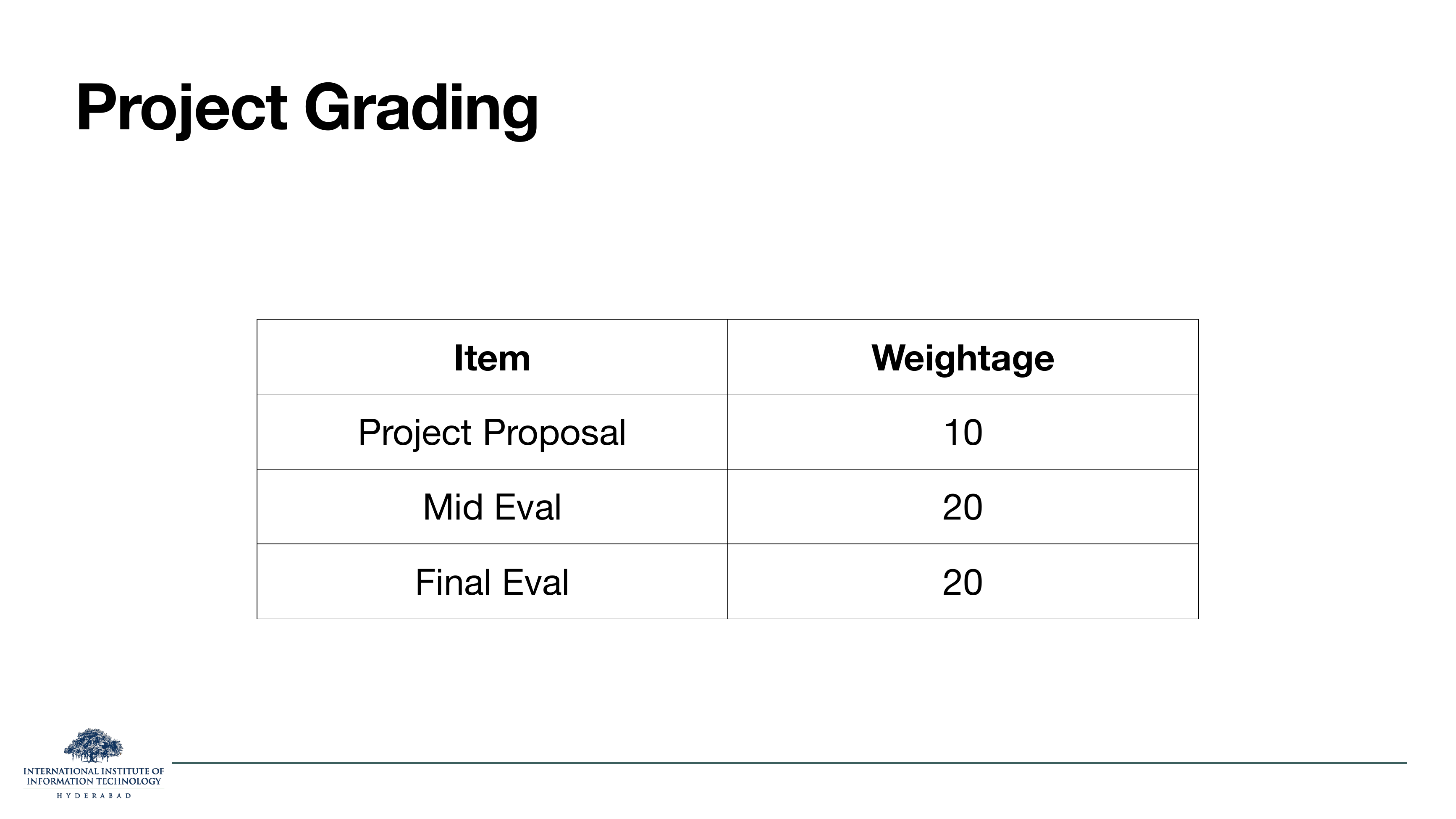
The 50 project marks split three ways: proposal 10, mid-eval 20, final-eval 20.
Why keep this in mind
The proposal carries the same weight as an assignment, and the mid-evaluation is worth as much as the final one. A clear early plan and steady progress matter; this is not a project to leave until the last week.
§6The course website
On the slide
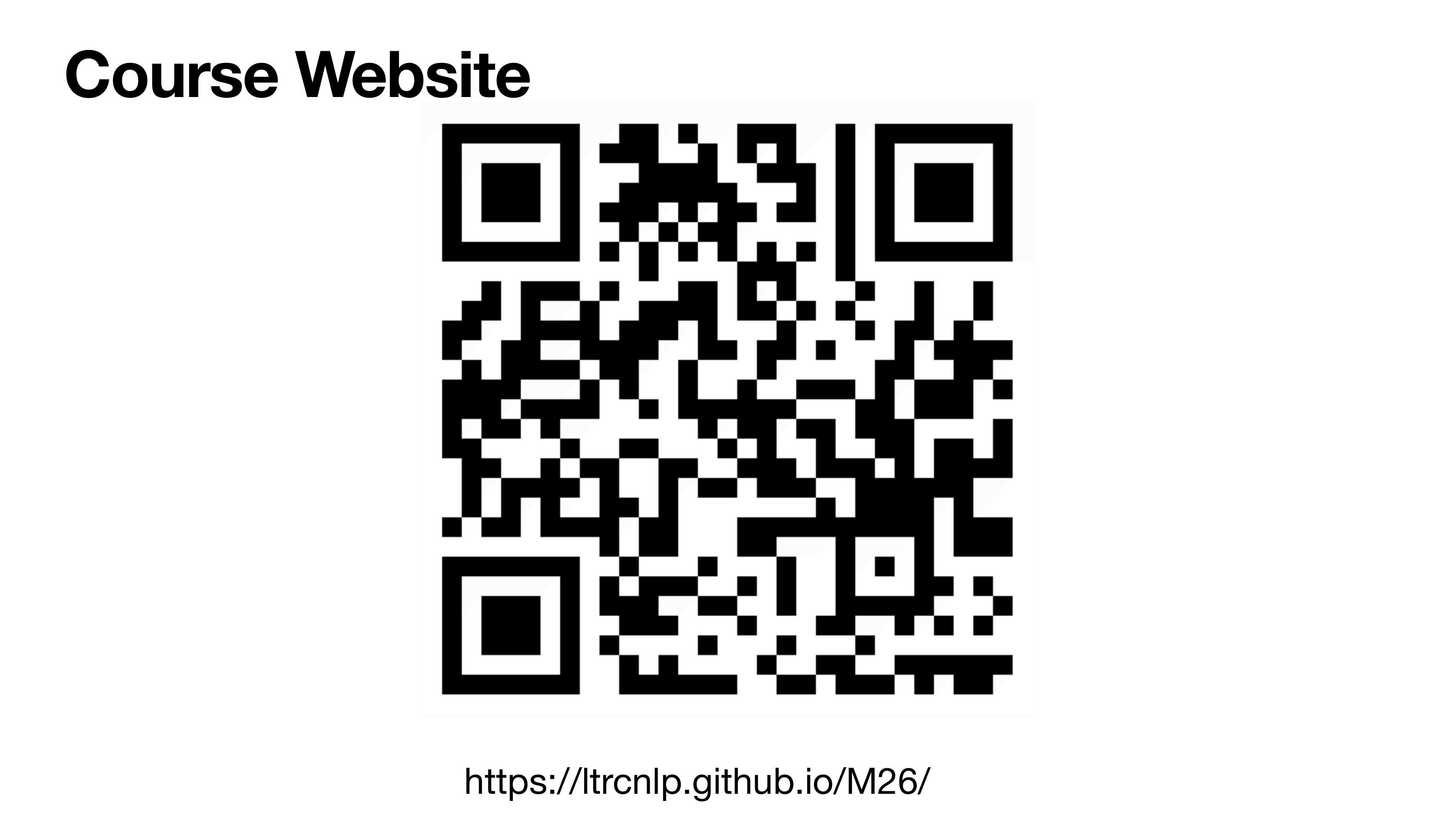
A QR code pointing at https://ltrcnlp.github.io/M26/, the course website.
Why keep this in mind
This site hosts the slides, assignment PDFs, seminar forms, proposal templates, and final schedule. Keep it bookmarked.